
Why Do Flies Go By SO Many Names?
Demystifying a common confusion amongst anglers
Join Our List for More Premium Content
Fly tyers drink too much. That’s why individual flies go by so many names.
Article over, thanks for reading.
KIDDING — obviously, fly tyers drink just as much beer as any angler. And, like all anglers, they enjoy their secrets. I’ll get more into that later, though.
Truth of it is, flies go by a bunch of names for lots of reasons. That’s why it takes so long to learn them. In all seriousness, it could take you about as long to learn insects + hatches, as it might to learn the different names of fly patterns. They’re widespread, some are kinda silly — Sex Dungeon, Fly Formally Known as Prince…etc. — and they’re unpredictable.
Overtime, you’ll come to know these names. Even still, there ARE reasons that they’re called what they’re called, and below, I’ll give you a few of those reasons.
Creative Names Compliment the Creative Process
fly tyers are artists in their own right
The fly tying process is a creative process.
So, like artists that name their paintings, fly tyers often name their flies. And, like artists, they have total freedom over what the name might be. Hence, the RIO’s dry humper.
Fly tyers also understand that by giving their flies creative and memorable names, they can gain notoriety and/or clout anytime somebody ties, uses, and catches a fish on their fly.
Just think about it — after spending hours tediously tying a brand new fly pattern, you bring it (in all its creative glory) out to the river, and you start to catch trout with it. So, you dub that pattern… say… “Cat Poop.” You tell your friends about the magic of Cat Poop. They tell their friends (given you gave them permission to do so), and of course, give you credit. It all comes back to you — you get the hard earned glory! Boy, does it feel good too.
Creative Names Protect Secret Flies
Anglers are notorious secret keepers
On the other end of the spectrum, say a fly tier or a fly fisherman/woman doesn’t want clout, but instead, wants to keep their super spectacular fish-catching-machine-of-a-fly a secret.
A wild name, like Cat Poop, can also do that for them. I’ll give you an example scenario: you’re a fly fishing guide, you’re out on the river, and you’re clearly the only angler that’s hooking into any fish. So, desperate for a catch, another angler asks what you’re fishing with. Knowing that this particular pat’s rubberleg pattern gives you an edge to your business (clients always catch fish with it) you decide to keep the pattern a secret. So, you tell him that you’re fishing with a Cat Poop pattern. The angler nods, confused, and heads off on his merry way. Hopefully, he has some entomology knowledge of his own that he can utilize to figure out what the trout are eating. But, for now, you’re keeping your secrets. You continue to get more bookings, because you’re catching more fish, using your secret fly.
Now that you know WHY anglers name their flies…
How can you figure them out for yourself?
At this point, I’m assuming you’re asking yourself HOW to figure out what certain fly patterns are and why they work, considering their wide array of names.
So, I’ll give you a couple pieces of advice.
For starters, try not to get all hung up on the names to begin with. People name their flies for a variety of reasons, and at the end of the day, their reasons have nothing to do with fishing. Instead, their reasoning has everything to do with secrecy, clout, and maybe the little bit of beer in their bellies. So, hopefully this point demystifies the question a bit.
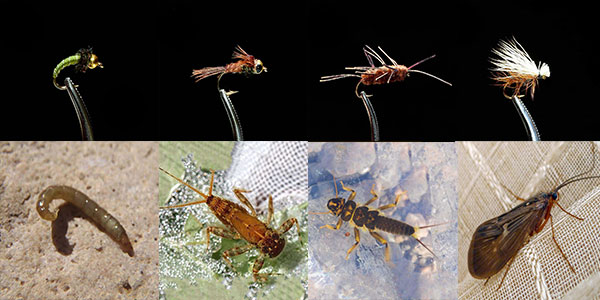
What really matters is your insect knowledge. If you haven’t already, study my Entomology Course (which you can get NOW for 70% OFF), and familiarize yourself with certain insect’s profiles and names. Know their shapes, and how many wings an adult insect of a certain species has and doesn’t have. Have the ability to pinpoint the difference between a mayfly, midge, stonefly, and caddis. This way, when you head out to the river and spot an olive mayfly that’s about the width of your finger, you can go to our fly box and find the fly that matches. As a result, you’ll catch more fish — no matter what the name of that fly is.
All in all, trout don’t care what certain flies are called. They ONLY care that what you’re throwing, looks like what they’re eating. So, while you now know WHY anglers call flies certain names, like I mentioned before, try not to get too hung up on it. Because, while these names are occasionally hilarious, names of flies really don’t matter. What matters, when it comes to catching fish, is your Entomology knowledge. Thanks again for reading.
|
|
|
|
 KATIE GILBERT
 KATIE GILBERT
Over and tr-out!
Limited Time Deal!
Online Entomology Course
Normal Price: $199.99 | Lifetime Access: $49.99 (75% Off)
Fully Online | Self Paced | Lifetime Access
109 Pages | Video Shorts | Pics | Diagrams | and More
Online Entomology Course
- Learn all 23 bugs above and under the water (all stages of each major insect)
- Available On and Offline Through our website and app
- Online = Self-Paced, Unlimited, Lifetime Access
- Useful for anyone who fishes for trout (worldwide)
- Learn how to match any bug to any fly and catch more fish
- Eight easy to follow lessons to master the knowledge
- 100+ Pages, Video Shorts, Pics, Diagrams and More
- Offline PDF available if you want to read in your hands
- FREE Bug Seines (on request) to identify insects (Free shipping too!)
