Top Nymphing Questions Answered
Become the Angler You Want to Be
Traditional nymphing is tricky.
Months into practicing the technique, you may still hit roadblocks you weren’t expecting. You’re an angler — terrible tangles, lost fish, and missed strikes are inevitable!
But, the more challenges you face and overcome while on the river, the better fisherman you become. With great reward (gorgeous trout) comes great struggles, (knots, flies stuck in bushes and trees…you get it). That’s just the name of the game.
Even still, there are small ways to improve your nymphing skill now. You’ve been filling my inbox with questions about traditional nymphing, so here are your five most frequently asked questions, answered:
Enjoy this free content, but also consider upgrading to our premium online course on Classic Nymphing. Simply click below to learn more about it (and the sale we’re doing for a limited time).

Question #1
How do I set up my nymphing rig?
Let’s start with what you’re going to need:
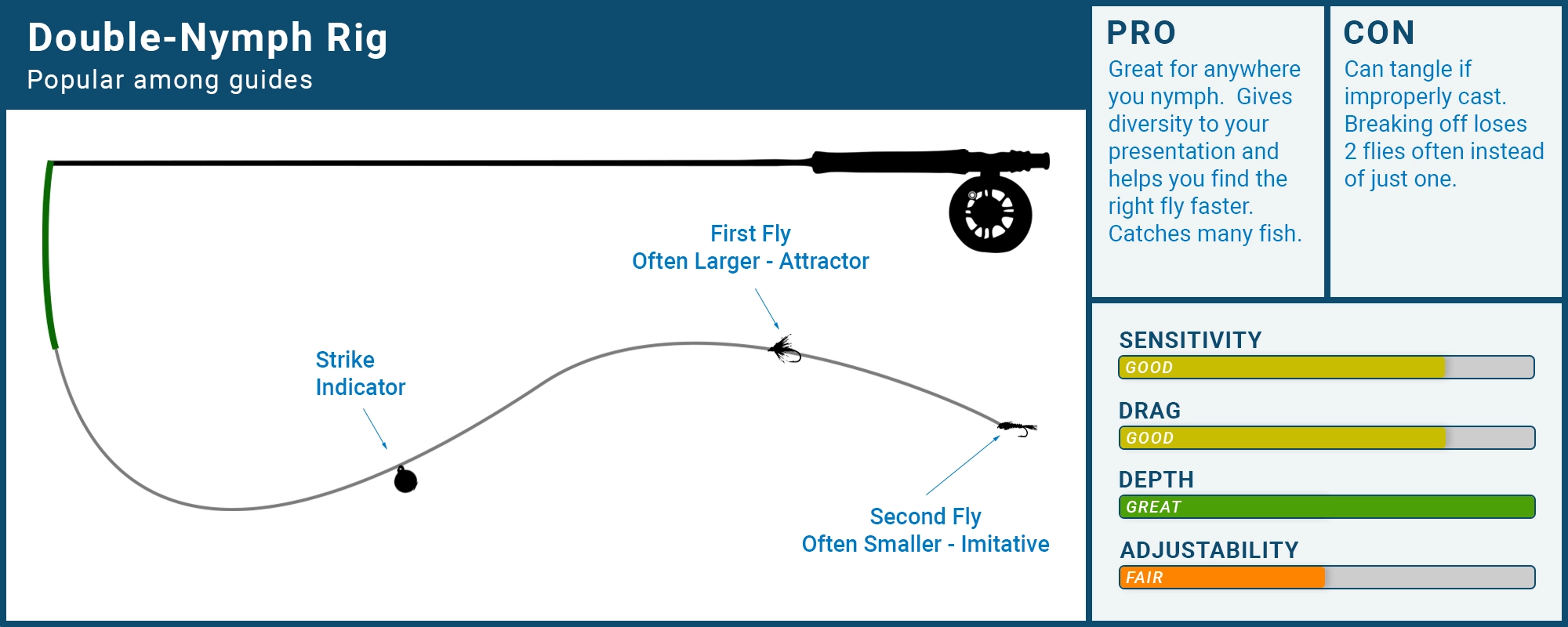
- A strike indicator. More specifically, the smallest indicator you can get away with — as long as your fly doesn’t cause your indicator to sink in the type of water you’re fishing, you’re good to go. This will improve your strike detection, and it will reduce your wind drag as you cast through the air. As a result, less tangles will occur. Something we all love to hear.
- Fly(s). You’ll want one, two, or three flies for your set up, depending on what your state regulations allow. You’ll also want to choose how many flies to fish with based on your own skill level as an angler. If you’re going out for the very first time, maybe use one. If you’re a beginning to intermediate level angler, give two a shot. And, if you’re really feeling it, tie on three. Why knot. And remember, the more flies you have on the better chance you’ll have one the trout will eat, so always fish the most number of flies you’re allowed and feel comfortable with at your skill level.
- A split shot. This will give your rig a little weight, which you’ll probably need if you aren’t using weighted flies (and sometimes even with weighted nymphs). As a result, your flies should better sink to the bottom of the river — where the fish are. It’s often said the difference between a good angler and a great angler is one split shot. Getting your flies where the fish are feeding is often a matter of weight, so make sure to give a split shot the consideration it needs.
Now, where does it all go? For starters, the distance between your indicator and your flies should be roughly 1.5x the depth of the water you’re fishing. Of course, if you find that you’re catching bottom, you can adjust accordingly. Then generally, you’ll attach the split shot to the leader above your flies 8-16’’ above the first nymph. Finally, below that, you’ll tie on the delicious looking flies — placed six to twelve inches apart if you’re using multiple.
This is a great start, but we have an entire section of our Classic Nymphing Course dedicated to all aspects of rigging up. From rods, reels, lines, leader, tippet, rig setups, situational adjustments… I can go on, or you could check it out for yourself →
Question #2
How Do I detect a strike?
Keep your eyes peeled for micro movements. Anytime the indicator shifts in a way that’s different from what the current is doing, go ahead and set that hook.
Whenever I’m out indicator nymphing, there are three types of movement I typically look for — the indicator going under (the obvious one), the indicator popping above the water’s surface, or the indicator going quickly up stream, down stream, or sideways. Slowing could also be a sign that a fish is on, or you’ve hit bottom. Even so, always pretend like there is no bottom — only fish. More often than not, you’ll be right.

It’s important to point out, though, that different strike indicators move in different ways. Plastic thingamabobber strike indicators and wool-based New Zealand strike indicators are going to behave differently on the river’s surface. And, of course, the larger the bobber, the more buoyant it’s going to be — meaning, it’ll have less strike detection sensitivity. In my Traditional Nymphing Course we cover the properties of strike indicators which include buoyancy, sensitivity, maintenance, adjustability, and damage to your leader/tippet. Different strike indicators will perform differently and learning to use the right one is an excellent skill to improve your nymphing abilities.
So, while a big thingamabobber is easier to see and track, you’ll probably have more success with a wool indicator as long as your rig isn’t dragging it under all the time. If you’re a beginner or an intermediate-level angler, I’d recommend giving the wool-based indicator a try as you can typically detect strikes a lot better.
Question #3
Why do I keep Losing fish after I hook them?
You’re probably losing fish for one of two reasons — you aren’t paying close enough attention to your strike indicator, or you have tons of slack in your line. Let’s start with the first.
In an attempt to avoid any false accusations, just imagine you weren’t watching your strike indicator (ugh, how could you). It goes under, the friends you’re fishing with scream at you to pay attention, you attempt to set the hook five seconds too late, and you miss the fish of a lifetime. Finally, the monster trout that never made it into your net consumes your every waking thought, and you don’t sleep for three days.
Alright, I’m joking. The point is, if you aren’t paying close attention to your indicator, odds are you aren’t going to set the hook in time to catch the fish. Simply because there’s already a decent amount of slack line that exists underneath the strike indicator due to river currents. So, if you add more delay on top of the delay that’s inevitably going to happen already because of the pre-existing slack, you’ll end up missing more fish. Or, you’ll snag it, but the hook won’t be lodged into the trout’s mouth as well as it should be, and you’ll lose it during the fight. So pay attention, watch for that strike, and set the hook as quickly as possible. Think of it as a ‘pop goes the weasel’ sort of game — let the anticipation build as you watch the drift. Trust me, it’s a really fun way to nymph. You can say “POP!” too every time you set the hook (you’re fishing friends won’t get annoyed I promise).
The other reason fish aren’t making it into your net? Poor line management. If you don’t keep your line tight, again, because of the slack, it’s going to take you far too long to set the hook. And you’ll lose the fish during the fight because the slack line will give the trout the ability to spit the hook when the hook lacks tension from a tight line. So instead, only keep as much line as you need in the water. Keep your rod tip high, and your line tight. That’ll help bring the fish in.
Question #4
I keep getting tangled when I cast with two fly rigs and an indicator.
How do I prevent this?
The short answer: you’re probably false casting too much.
This happens to all of us — myself included. If I’m working with a three fly rig + a strike indicator and a split shot, there’s going to be a LOT of objects of various sizes moving all at once when I cast. As a result, things are going to get knotty quickly. Really knotty.
Instead, water load before you cast or give a roll cast a try. I typically roll cast down stream, and back up stream. Or I’ll roll cast down stream, and water load back up stream. My dry fly techniques don’t apply when I nymph whatsoever — and neither should yours. If you want to minimize your tangling, you shouldn’t be casting using tight loops and false casts. Instead, utilize the water load, the flick, and the roll cast. You’ll get tangled less, and you’ll probably be a much happier camper.
There is another option, too – you could use heavier tippet. Sure, you might catch less fish. Even still, 2X, 3X, or even 4X is going to get a lot less tangled than your 6X tippet. This is because heavier tippet will stay straight more often and is less-pliable making it less susceptible to getting tangled during casting or the drift. Heavier tippet is also much easier to see, feel, and work with overall, and I often recommend it to beginner-intermediate anglers. Another factor to consider!
Learning the Water Load, as offered in our Classic Nymphing Course, can help keep the false casting to a minimum
Question #5
How do I get better at nymphing?
Educate yourself. Educate yourself. Educate yourself.
Of course, practice helps too. But if you don’t read about the techniques you plan to practice on the river before you actually head out there, you might end up developing bad habits. Which can be really hard to undo. Investing in your fly fishing education is the single best investment you can make to improve at this sport.
So, instead, do some reading (like you are right now! Good work). Learn exactly what you should be doing before actually going out and doing it. And the next time you go fishing, pick one to three things to work on. I like to focus on one skill per outing, and I usually spend a solid hour focusing on just that skill. If you do the same, the hope is that at some point that specific skill will become automatic muscle memory.
For instance, if you practice really, really, really intentionally watching your indicator for at least a half an hour the next time you go out to fish, you’ll become used to it. And then the next time you hit the river, it’ll be something you just do. All of a sudden, you’ll stop missing strikes, and you’ll catch more fish.
Once these skills are developed, you can start thinking about other variables that are affecting your nymphing — fly selection/presentation/location. All of these variables — variables that will make you a better angler — I cover in depth in my Classic Nymphing Course. It’s essentially your guide to becoming the ultimate nympher — from rig set up, to selection, to drift. For now, I hope this helps you to catch more fish the next time you go nymphing.
Over and tr-out!
Learn Classic Nymphing
The Right Way
Access step-by-step expert instruction,
immersive visuals, and lifetime access.Was $199 | Now $99 ($100 Off)
Have You Tried One of Our Courses?
Lifetime Access | Exclusive Coupons | Comprehensive Education
-

Fly Fishing Entomology Course
$199.00 -

Euro Nymphing Course
$199.00 -
Dry Fly Fishing Course
$199.00 -

Classic Nymphing Course
$199.00 -
Streamer Fishing Course
$199.00 -

Top Trout Flies Course
$99.99 -
Crafting Your Fly Box Course
$99.99 -
Modern Nymph Flies Course
$59.99 -