Five Hacks that will Make
Your Nymphing Game Superb
Learn these Tricks + Catch more fish
Looking to make your nymphing game top notch?
Well, you’re in the right spot! Below I’ve curated a list of five essential hacks that’ll make your nymphing game better than it’s ever been, so you can hook into more trout than you ever thought possible. Heck, let’s call them tips for trout.
Before I get into all that, though, I want to reiterate that all of these hacks come from fifteen years of personal experience — nymphing myself, as well as teaching intermediate + beginner anglers to better their skills. Time and time again, I’ve seen these tips help fly fishermen (as well as myself) bring in more fish.
So, if they work for all of us…these hacks will most certainly work for you. And, if any (or all) of the techniques I list resonate with you, be sure to check out my Classic Nymphing Course, where I unpack each in much more detail.
For now, here are five quick ways you can make your nymphing game superb today:
Fishing the Right Indicator
Nymphing Hack #1
Fact: Fishing the right indicator has a huge impact on your ability to detect strikes.
I’ve come across plenty of anglers who are “thingamabobber for life” — that’s all they’ll ever fish. If you’re in the die-hard thingamabobber category, that’s fine. But remember, there are different sizes, different colors of thingamabobbers, and certain rivers are going to be extra picky.
Seriously, some trout are really picky — like my kids eating veggies. On occasion, unless you’re using the correct color or size of indicator, you will spook fish. On pickier rivers, I often use white to imitate foam, or if there’s low light, I’ll use a black indicator (very visible to my eye, but not to the fish’s eye).
Outside of the classic thingamabobber, though, there are all sorts of indicators you can try out. There are yarn indicators, cork indicators, plastic indicators, foam indicators that you pinch on, sighter line — and every one has its pro’s and con’s in certain situations (situations I outline in detail in my Classic Nymphing Course). Read up there, and you can actually learn which are best in any possible situation. Because, as I mentioned before, fishing the right indicator can really have a much bigger effect on your ability to catch fish than you think. So switch it up!
Here’s an example diagram from the course, we go over each indicator type in detail and show the situational purposes for each indicator.

Fish More Flies
Nymphing Hack #2
Most people start out with one fly because they don’t want to get tangled up too often. I totally get that — it’s a good way to start.
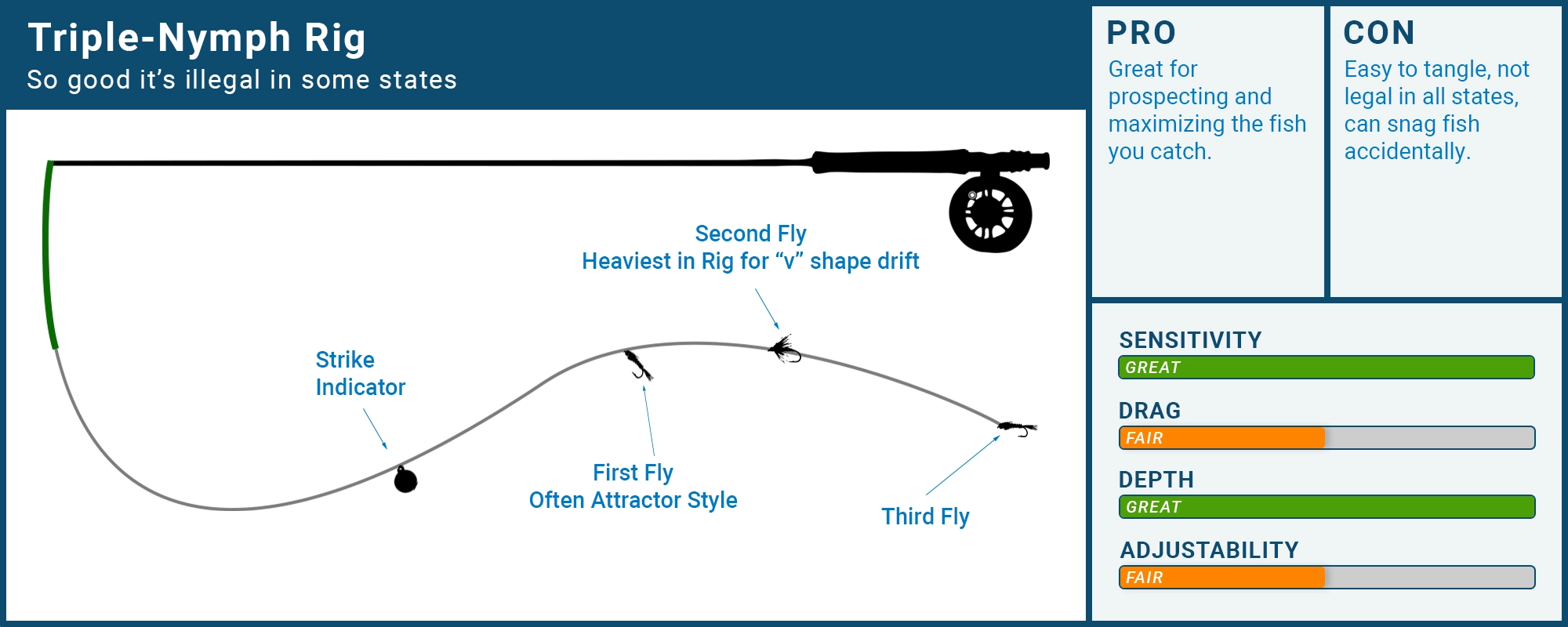
Still, once you’re feeling ready to try to improve your fishing game faster, two flies is phenomenal. Three flies is even better — if your state will allow it.
Here’s why:
- When you fish multiple flies, you’re presenting multiple patterns to the trout. And as a result, you’ll figure out what they’re munching on much faster. For example, the trout you’re hoping to hook may not be eating stoneflies that day, but they may be really hungry for caddis. If you have both on your rig, you’ll figure that out twice as fast as you would’ve if you were to switch off flies with a single fly set up.
- When you fish multiple flies, you’re going to be fishing multiple depths. And as a result, you’re going to get your flies in front of more fish. Every fly will travel through a different water column, where different fish are sitting in the water. It’s true that more often than not fish are going to eat those bottom flies — it’s just what happens. Even still, the more water your flies are traveling through, the more likely a fish will see one, think it looks real tasty, and want to eat it.
At the end of the day, fishing more flies is always going to improve your odds of catching more fish. You’ll quickly get those numbers up, AND you’ll learn more about what they’re eating. It’s a win, win.
Cast for Show, Drift for Dough
Nymphing Hack #3
Sure, an excellent cast might impress your friends. But it sure as heck won’t impress the fish.
What I’m meaning to say is, your cast isn’t really what’s going to catch fish. It’s responsible for some of the accuracy, sure, but your drift is really what counts. A good drag free drift, a good presentation, and an accurate cast into the feeding lanes where trout are — that’s what’s important. You don’t need to look like Brad Pitt in A River Runs Through It to have an accurate cast.
So, the next time you go out, instead of obsessing over how beautiful your cast looks, focus on that drift. Lock your eyes to that indicator, and diligently work on getting that drag free drift. If you can do both of these things consistently, you’re going to find fish.
Lastly, be sure to adjust your depth. A lot of people make the mistake of going with a three foot drift all day, but then they go from fishing two-foot-deep holes to six-foot-deep holes. In neither of those is a three foot rig really helping you all that much.
If your rig doesn’t match how deep the river is, and how fast the water’s flow is, you’re going to have trouble catching fish. If you take my Classic Nymphing Course, you can plug this specific information to figure out what depth you should be fishing at depending on the conditions.
Avoid Rootitis
Nymphing Hack #4
If you’ve been diagnosed with Rootitis — the incessant need to stand and fish the same hole all day long — talk to your physician or local fly shop immediately. On behalf of anglers everywhere, please get help.
Okay, I’m mostly kidding. But, while “Rootitis” may not actually be bad for your health, it’s probably harming your ability to catch more fish. It’s also, to be blunt, not as fun.
For starters, if you’re camped out in the same spot all day long, you’re going to miss out on some really cool scenery up and down the river. Trust me, choosing not to explore is a total shame — for all you know, the most beautiful, trout-filled hole you’ve ever seen in your life might be right around the bend. But you won’t discover it, unless you seek it out.
By sticking to the same spot all day, you’re also going to be missing a lot of hungry fish. My big-number days always happen when I cover a lot of water. Sure, I do it because I love to explore, but I also do it because it’s really just a good way to hook more trout.

The more water you cover — or, types of water you cover — the quicker you can figure out where the fish are eating. Then, you can continue to fish that type of water for the rest of the day + probably head home with a huge smile on your face, because you caught more fish than you imagined.
Don’t Set Any Expectaions
Set Goals and Have Fun
Nymphing Hack #5
The difference between goals and expectations?
When you set goals, you probably aren’t imagining that you’ll actually hit them right away — goals are meant to be audacious and exciting. Goals drive your success, feed your desire to become a better fisherman, and hopefully, eventually, are achieved.
Expectations, on the other hand, tend to harm your success on the river. For example, if you’re brand new to nymphing, you might expect to catch zero fish your first time out. At that point, you’ve already decided that you aren’t going to catch anything, and therefore, when you’re actually out on the river, you aren’t going to try as hard. Big bummer.
Instead, set a goal for yourself. If you’re brand new, decide that you’re aiming for a five fish day. If you’re more experienced, set a goal for a ten to twenty fish day. Heck, you might hit the number! And if you don’t, no problem. It’s a goal, and you’re out there to have a good time — and hopefully, focus + practice a few specific techniques.
Expand your limits. Dream a bit. And have fun. You’ll become a better angler as a result.
Over and tr-out!
Try Our Courses and Improve Your Fly Fishing Instantly
Lifetime Access | Exclusive Coupons | Comprehensive Courses
-

Dry Fly Fishing Course
$199.00 -

Classic Nymphing Course
$199.00 -
Streamer Fishing Course
$199.00 -
Fly Fishing Entomology Course
$199.00 -

Euro Nymphing Course
$199.00 -

Top Trout Flies Course
$99.99 -
Crafting Your Fly Box Course
$99.99 -
Modern Nymph Flies Course
$59.99 -