
How to Figure Out the Trout When You Start Fishing
The Three Pillars: Your Decision-Making Framework
If you’ve ever walked up to a river, rigged up, made a dozen casts, and walked away wondering what went wrong, this article is for you.
Most anglers don’t struggle because they lack skill. They struggle because they don’t have a repeatable process for figuring out what the fish want on any given day. They show up, pick a fly that worked last time, find a spot that looks good, and start casting. Sometimes it works. More often, it doesn’t. And when it doesn’t, they’re left guessing.
What you actually need is a diagnostic framework. A way to look at the water, gather information, and translate what you’re seeing into decisions that put fish in the net. That’s what this article is about.
We’re going to walk through the process from the moment you park the truck to the moment you’re dialed in and catching fish. Then we’ll run through three realistic scenarios that show how the framework plays out in different conditions. By the end, you’ll have a clear mental model you can take to any river, any season.
The foundation of everything here is a simple equation: Location + Fly Selection + Presentation = Catch Fish. These are the three pillars of fly fishing success, and every decision you make on the water connects back to one of them.
If you want to go deeper on all three pillars with guided instruction, check out Trout University VIP — the first 30 days are free, and it’s built specifically to help anglers like you build a complete, systematic approach.
If you’re ready to stop guessing and start fishing with a plan, let’s get into it.
If you want a structured way to build these skills faster, the Trout University VIP membership is worth a look. It’s free for the first 30 days and covers all three pillars in depth.
Before we get into the step-by-step process, it helps to understand why this framework exists and what it actually solves.
Most fishing problems fall into one of three categories:
- You’re not in the right place (Location)
- You’re not showing them the right fly (Fly Selection)
- You’re not delivering it convincingly (Presentation)
That’s it. Every bad day on the water traces back to one or more of those three things. The three pillars give you a way to diagnose the problem instead of just casting harder and hoping.
Location is the foundation. It means choosing the right river, the right section of that river, and the right type of water within that section. It also means understanding how conditions like flow, temperature, clarity, and season affect where fish are holding. You can have the perfect fly and a flawless drift, but if you’re fishing water that doesn’t hold active fish, nothing else matters.
Fly Selection means choosing a fly that matches what trout are actually eating right now, not what worked last week or what looks cool in your box. It requires some knowledge of entomology, some observation skills, and a willingness to adjust based on what the fish are telling you.
Presentation is how you deliver the fly. The cast, the drift, the depth, the angle, the mend. Even the right fly in the right location will get refused if it’s dragging unnaturally or riding at the wrong depth.
Here’s the key insight: when fishing is slow, one of these three pillars is off. Your job is to figure out which one and fix it. That’s the entire game.
Trout University
The Best Way to Master Fly Fishing for Trout
Everything you need to learn how to fly fish for trout.
From fly selection to presentation and location, all in one place.
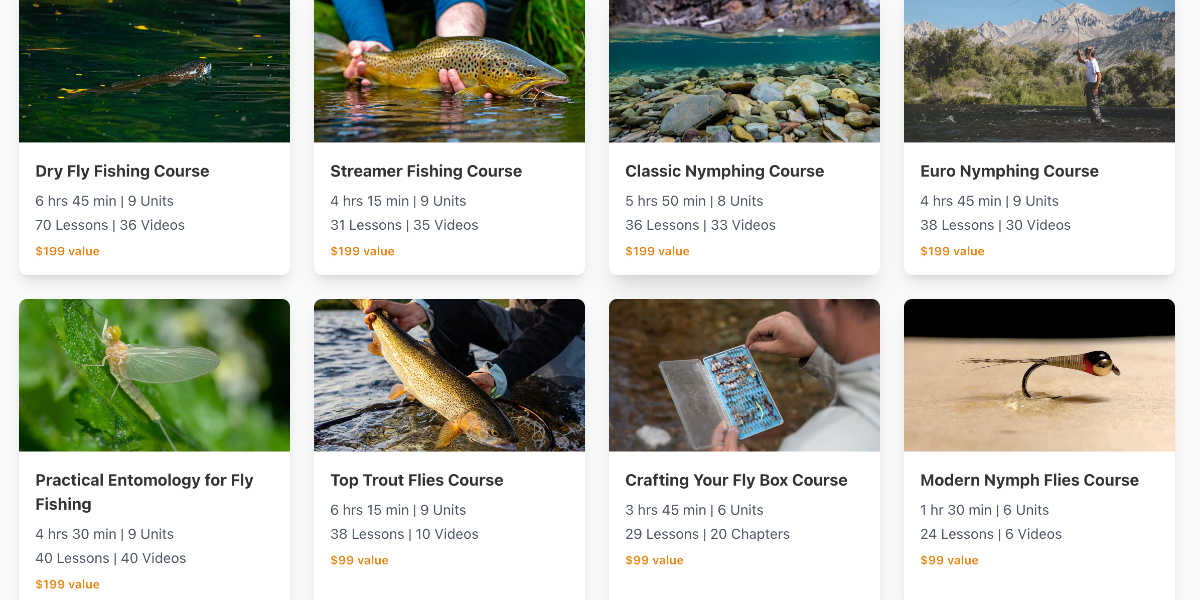
8 Premium Courses
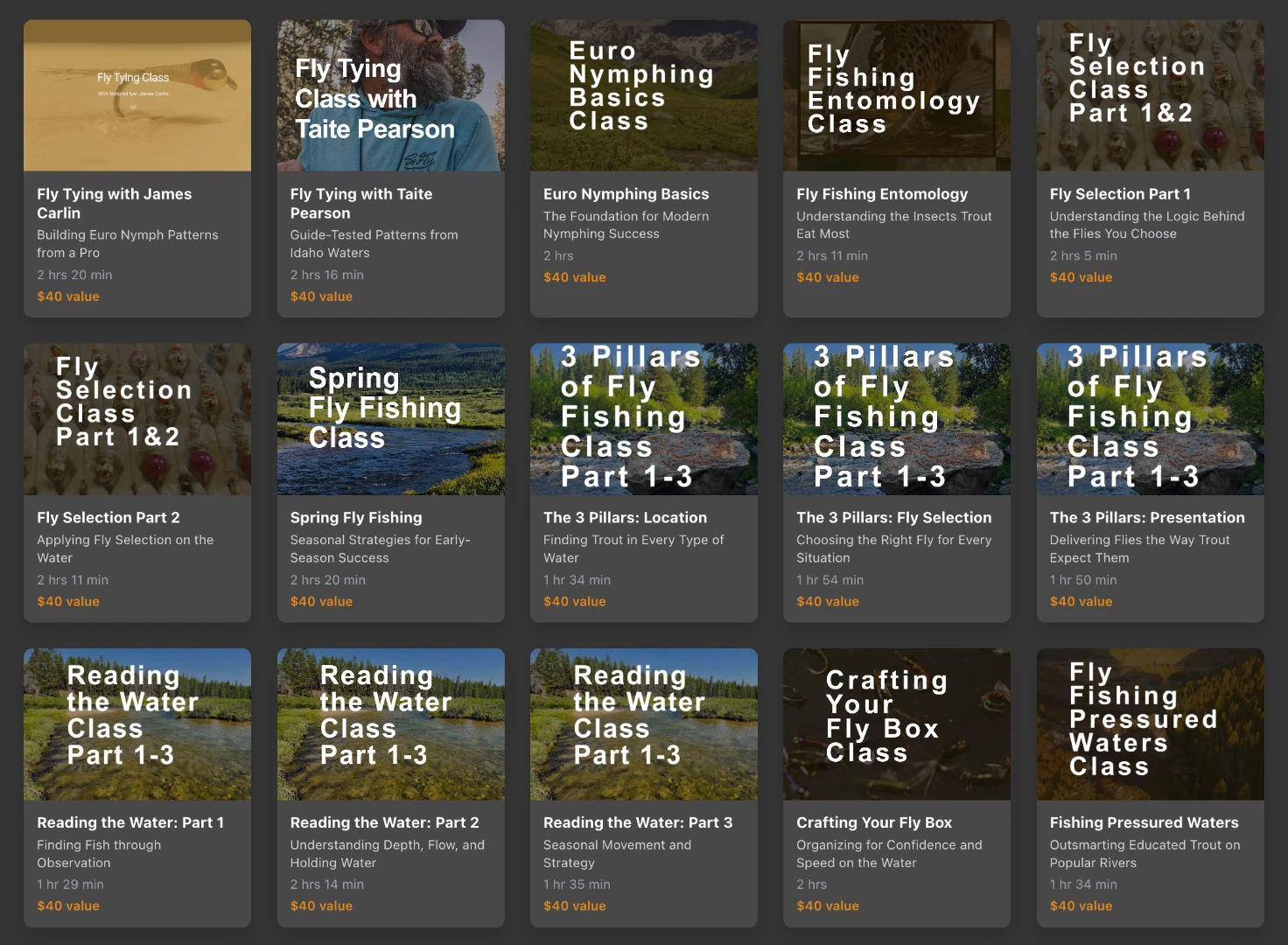
15 Video Classes
1-2hr Power Classes on Key Subjects and solidify your learnings
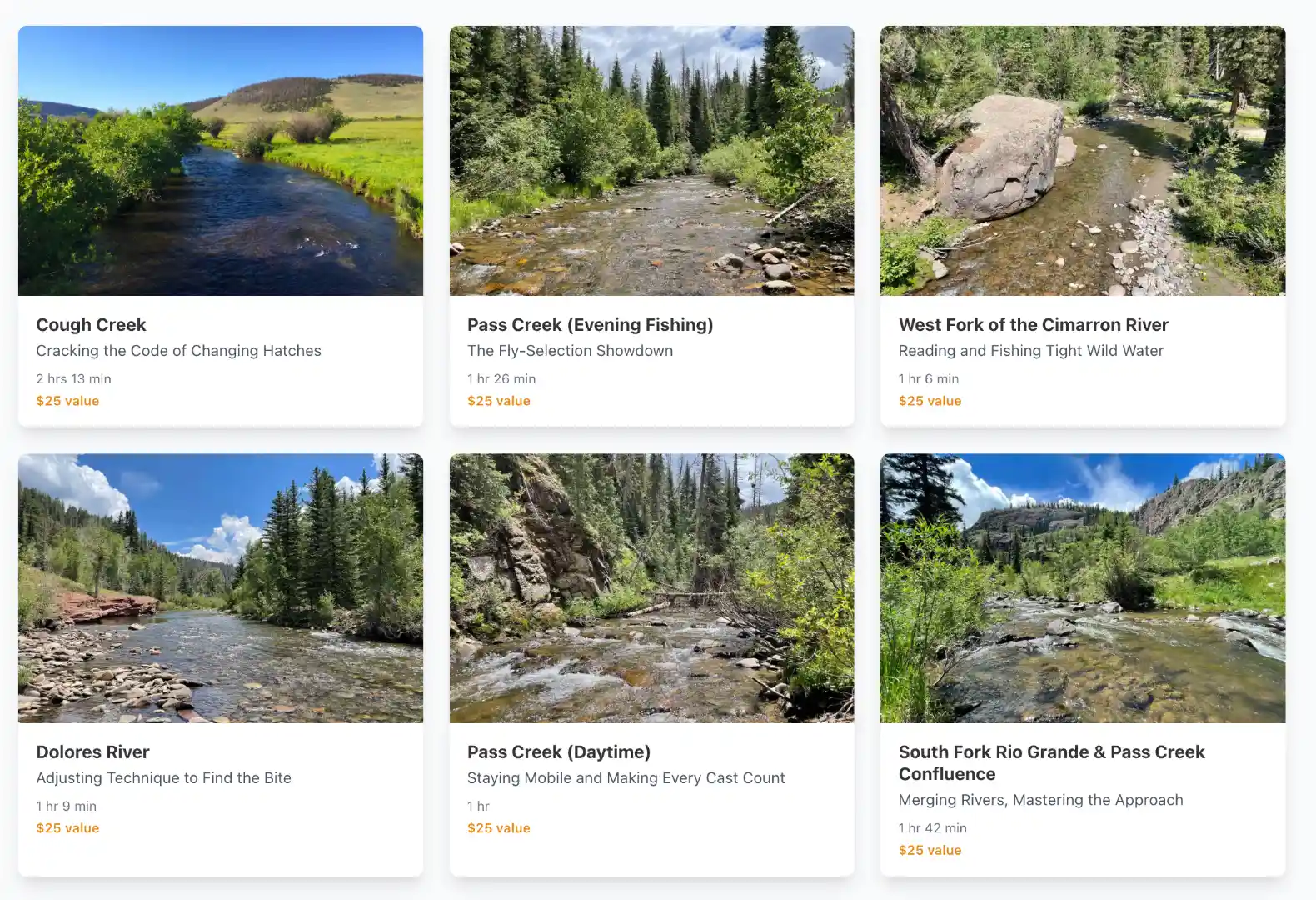
6 Streamside Courses
10+ Hours of Fishing to See Our Methods in Action
No Credit Card Required or Auto Renewal
Step 1: Don’t Cast Yet
This is the most common mistake beginners make, and honestly, a lot of experienced anglers do it too. You pull up to the river, you see water, and your instinct is to get your fly in it as fast as possible.
Resist that instinct.
Spend the first five to ten minutes just observing. Stand back from the bank. Look at the water. Let your eyes and brain gather information before you start making decisions.
Here’s what you’re looking for:
Water clarity and flow. Is the river running clear, slightly off-color, or blown out? High and murky water changes everything, from where fish are holding to what flies will work. Clear, low water means fish can see you and your fly very well, which demands a more careful approach.
Surface activity. Are fish rising? Are there insects on the water or in the air? Even subtle surface rings in a slow pool tell you something important: fish are actively feeding near the surface, which narrows your options considerably.
Current structure. Where are the seams? Where does fast water meet slow water? Where are the foam lines, the eddies, the deeper pockets? These are your target zones. Trout hold where they can access food without burning too much energy, and current transitions deliver food to them like a conveyor belt.
Insect activity. Look at the air above the water. Look at the surface film. Shake a streamside bush or tree branch and see what flies out. These are clues about what’s hatching and what stage the insects are in.
Key rule: What you see in the air is not necessarily what the fish are eating. Adults flying around don’t mean trout are eating adults. They might be eating emergers just below the surface, or nymphs near the bottom. Behavior tells you more than bug sightings.
This observation phase is where your Location pillar gets refined. You’ve already chosen the river and the general section. Now you’re narrowing down to specific beats and water types where fish are most likely to be active right now.
Step 2: Get in the Water and Investigate
Once you’ve done your visual scan from the bank, it’s time to gather more specific information. This is where a bug seine becomes one of the most valuable tools you own.
A bug seine is a fine-mesh net you hold in the current to capture what’s drifting subsurface. This is called the “dinner plate” method, and it shows you what trout are actually being served, not just what insects happen to be flying around.
How to use it:
- Find a spot downstream of the water you plan to fish.
- Hold the seine in the current for 30 to 60 seconds.
- Pull it out and examine what’s in it.
- Look for the most abundant insects by size, color, and type.
You can also flip rocks on the streambed to see what nymphs and larvae are living there. This tells you what’s available in the substrate. Combine that with what’s drifting in the seine and you start building a picture of what trout are most likely keying on.
A few things to look for when you examine your seine:
- Size. This is often more important than exact pattern. If everything in the seine is tiny, go smaller than you think you need to.
- Color. Olive, brown, black, cream, and rust cover most situations, but the seine will tell you if something specific is dominant.
- Life stage. Are you seeing nymphs? Pupae? Emergers? This tells you where in the water column the fish are feeding.
If you flip twenty rocks and find almost no insect life, that’s important information too. Sparse bug life often means sparse fish. Consider moving to a different section or a different river entirely.
Quick fix: If you don’t own a bug seine (that we offer for free in our Fly Fishing Entomology Course, shake streamside vegetation over your hand and see what falls out. It won’t tell you what’s drifting subsurface, but it gives you a starting point for adult and terrestrial activity.
Step 3: Choose Your Starting Fly
Now you have actual information. You’ve observed the water, checked the surface, and seined for subsurface insects. Time to make a fly selection decision.
The key word here is “starting” fly. You’re not committing to one fly for the day. You’re making an educated first guess and then letting the fish refine your choice.
Here’s a simple decision tree:
If you have clear evidence of a specific hatch: Match the stage and size of what you’re seeing. If you seined a bunch of small olive nymphs, start with a small olive nymph. If you see emergers in the film and fish are sipping subtly, start with an emerger pattern at or just below the surface.
If you have no clear evidence: Start with a seasonally appropriate generalist or attractor pattern. In early spring, that might be a small olive-toned nymph that covers BWOs, early caddis, and larger midges. In summer, a small hare’s ear or pheasant tail covers a lot of ground. The goal is to cover multiple likely food sources with one fly until the fish give you more information.
On size: Go smaller than your instinct tells you. Most insects are smaller than a size 12. In tailwaters especially, size 16, 18, and even 20 patterns are the norm, not the exception. If you think a 16 makes sense, try an 18.
On depth: This is part of fly selection and presentation working together. If you’re nymphing, you need to get your fly into the strike zone, which is the slower water near the riverbed where trout spend most of their time. Start with enough weight to reach the bottom, then adjust up from there.
Step 4: Fish It, Then Adjust
Here’s where a lot of anglers go wrong. They tie on a fly, make three or four casts, don’t catch anything, and immediately change flies. Then they do it again. And again. By the end of the session, they’ve cycled through half their box and learned nothing.
Experts do the opposite. They let a fly fish long enough to actually gather information.
Give each fly a real chance. Fish it through multiple drifts, at different depths, in different current lanes. If you’re not getting takes after a thorough effort, then consider changing. But change one variable at a time.
The adjustment sequence:
- First, adjust depth and weight. Most nymphing problems are depth problems. If you’re not in the strike zone, the fly doesn’t matter.
- If depth feels right and you’re still not getting takes, adjust your drift. Are you getting drag? Is your mend good enough? Is the fly moving at the speed of the current near the bottom, not the surface?
- If your presentation feels solid and you’re still blank, then change the fly. Try a different size first, then a different profile or color.
Intermediate refinement: When you change the right variable, results often come within one or two casts. That’s how you know you’ve found the answer. If you change something and nothing happens after another thorough effort, that variable wasn’t the problem.
The goal of this adjustment process is to build a pattern. One fish is not a pattern. Two or three fish from similar water types, on the same fly, with the same drift, is a pattern. Once you have a pattern, commit to it and stop wasting time on water that isn’t producing.
Step 5: Keep Reassessing Throughout the Day
Rivers are not static. Conditions change. Hatches come and go. Cloud cover shifts. Water temperature rises through the afternoon. Fish that were holding in one spot at 9 AM may have moved by noon.
The best anglers treat the entire day as a continuous loop of observation and adjustment. Every hour or so, ask yourself:
- Is what was working still working?
- Have conditions changed? (Light, temperature, wind, hatch activity)
- Are fish still in the same locations, or have they moved?
If you were catching fish on nymphs and suddenly fish start rising, that’s a signal. Fish have moved higher in the water column. Lighten your rig or switch to a dry fly or emerger. Don’t stubbornly stick with what was working an hour ago if the river is telling you something different.
This is the three-pillar framework in action. When things change, you cycle back through Location, Fly Selection, and Presentation and ask which one needs to be adjusted.
Three Scenarios: The Framework in Action
Let’s make this concrete. Here are three realistic situations you might encounter on the water, and how the process plays out in each one.
Scenario 1: Early Spring Morning, Clear Tailwater, No Visible Activity
You arrive at a popular tailwater on a cool March morning. The water is gin-clear and running at a normal, fishable flow. The air temperature is in the low 40s. There’s no visible surface activity. No rises, no insects in the air.
Location assessment: Tailwaters are generally stable and productive year-round because the water temperature stays consistent. In early spring, fish are often holding in deeper runs and pools where the current is slower and the water is slightly warmer. Look for the deeper bucket water, the slower runs, and the seams along the edges of faster current.
Observation: You seine the water and find a mix of tiny midges and a few small olive-colored nymphs that look like early BWO nymphs. Everything is small, size 18 to 22 range. Nothing is hatching yet, but the insects are present in the drift.
Fly selection: Start with a two-fly nymph rig. A small midge larva or pupa as your point fly, and a small olive nymph as your dropper. Both in the size 18 to 20 range. Use enough weight to get down into the slower water near the bottom of the run.
Presentation: In clear tailwater, fish can see you and your gear easily. Stay low, move slowly, and keep your distance. Focus on getting a dead drift at the right depth. The strike zone in a deeper run is close to the bottom, so your indicator or sighter should be moving slightly slower than the surface current. If it’s moving at the same speed as the surface, your flies are probably riding too high.
What happens: After a few drifts in the main seam of a deeper run, you start getting subtle takes. The fish are there, they’re eating, but they’re being selective about size. You try a size 16 and get fewer takes. You drop back to an 18 and the takes come back. Pattern confirmed.
The lesson: In clear, cold tailwater with no hatch, small midges and BWO nymphs are almost always the right starting point. Depth and presentation matter enormously because the fish have time to inspect your fly in that clear water. Get the size right and get it in the strike zone.
Scenario 2: Midsummer Afternoon, Freestone River, Fish Rising Sporadically
It’s July. You’re on a freestone mountain river. The water is low and clear, running at summer flows. It’s warm, probably 65 to 68 degrees in the afternoon. You can see fish rising sporadically in a long, slow tailout below a riffle.
Location assessment: In summer heat, fish need oxygenated water. The riffle above the tailout is doing that work, and fish are staging in the calmer water below it to intercept food coming off the riffle. This is a classic summer feeding setup. However, in water above 65 degrees, fish are under thermal stress. You want to catch them efficiently and release them quickly.
Observation: You watch the rises carefully. They’re subtle, not aggressive. Fish are sipping something small from the surface film. You see a few small tan-colored insects on the water that look like caddis, but the rises don’t look like caddis rises. Caddis rises are usually more aggressive and splashy. These are slow, deliberate sips. You shake some streamside vegetation and a few small PMD-style mayflies flutter out.
Fly selection: The subtle sipping behavior points toward emergers or spinners, not adults. Fish are eating something in or just below the film. Start with a small PMD emerger or a soft hackle in the size 16 to 18 range. If that doesn’t produce, try a CDC-wing dry fly that sits low in the film rather than high on its hackles.
Presentation: This is where the game gets technical. Slow, clear water means drag is your enemy. Every micro-drag will be seen by the fish. Use a longer, finer tippet. Make upstream or reach casts to extend your drag-free drift. Present to individual rising fish rather than casting randomly into the pool.
What happens: Your first few casts with a standard dry fly get ignored. You switch to a CDC emerger that sits flush in the film and immediately get a take on the third drift. Two more fish follow. The pattern is clear.
The lesson: Rise form tells you a lot. Subtle sipping almost always means emergers or spent spinners in the film, not high-riding adults. When fish are being selective in slow, clear water, presentation quality is the deciding variable. The right fly fished with drag is still the wrong fly.
Scenario 3: Early Fall, Slightly Off-Color Water After Recent Rain, No Rises
It’s late September. A rain event two days ago pushed some color into the river. The water is running slightly higher than normal and has a faint brownish tint. Visibility is maybe two to three feet. No surface activity at all.
Location assessment: Off-color, slightly elevated water changes where fish hold. They tend to move out of the main current and tuck into slower water near the banks, behind structure, and in eddies. The reduced visibility also means fish are less spooky and more willing to move for a fly. Look for the inside bends, the slack water behind large rocks, and the slower edges of runs rather than the main channel.
Observation: You seine the water and find a mix of larger stonefly nymphs and some annelid worms (the pinkish-red ones that get dislodged when flows rise). The insects are bigger than what you’d find in low, clear conditions. You also notice some leaf debris in the drift, which is typical for early fall.
Fly selection: This is a situation where you can go bigger and brighter than usual. A size 10 or 12 stonefly nymph is a legitimate choice. A San Juan Worm or similar annelid imitation is also highly effective after rain events because rising water literally dislodges worms from the banks and streambed. Add a hot spot or a bead for visibility in the off-color water. Flash and color help fish locate your fly when they can’t see as far.
Presentation: With reduced visibility, fish are relying more on lateral line detection and less on sight. Get your fly close to structure. Cast tight to the bank, drift along the edge of the current seam, and don’t be afraid to let the fly swing slightly at the end of the drift. In off-color water, you can get away with a less delicate presentation, but you still need to be in the right depth zone.
What happens: You start working the slower inside edge of a bend and immediately hook up on a stonefly nymph drifted tight to the bank. You work the same type of water for the next hour and find fish consistently in those slower, protected zones. The annelid imitation also produces well in the deeper, slower pockets.
The lesson: Off-color water after rain is not a bad day. It’s a different day. The fish are still there, still feeding, but they’ve repositioned and the menu has changed. Adjust your location targets, go bigger on the fly, and fish close to structure. Anglers who stick with their clear-water approach on these days struggle. Anglers who adapt often have some of their best sessions.
Why This Process Works: The “Why” Behind the Framework
It’s worth pausing to explain why this systematic approach produces better results than guessing.
Trout are not random. They hold in specific places for specific reasons, they eat specific things based on what’s available, and they respond to presentations based on how natural and convincing those presentations are. Every variable has a reason behind it.
When you follow the process outlined here, you’re essentially doing what the fish are doing: responding to the actual conditions in front of you rather than assumptions. The angler who shows up with a predetermined plan and refuses to adjust is fishing yesterday’s river. The angler who observes, gathers information, and adapts is fishing today’s river.
The three-pillar framework also gives you a diagnostic tool when things aren’t working. Instead of just feeling frustrated, you can ask a specific question: Is this a Location problem, a Fly Selection problem, or a Presentation problem?
- If you know fish are present but not eating, it’s probably Fly Selection or Presentation.
- If you’re getting takes but missing them or losing fish, it’s a Presentation problem (hook set, tippet, drift quality).
- If you’re getting zero interaction despite solid presentation, it might be a Location problem. Move.
This kind of structured thinking takes the emotion out of slow fishing and replaces it with problem-solving. That’s what separates consistent anglers from occasional ones.
Common Mistakes That Break the Process
Even with a good framework, there are a few patterns that derail anglers. Here are the ones worth watching for.
Changing flies too fast. This is the most common error. When you change flies before a pattern can develop, you never learn anything. Give each fly a real, thorough effort before moving on.
Ignoring depth. Most nymphing problems are depth problems. If your flies aren’t in the strike zone, which is that cushion of slower water near the riverbed, you’re fishing over the fish’s heads. Adjust weight before you adjust fly pattern.
Fishing one spot all day. If a spot isn’t producing after a genuine effort, move. Beginners often park at the first accessible spot and grind it out regardless of results. Be willing to explore. Each new section teaches you something.
Matching what you see in the air, not what’s in the drift. Adults flying around don’t tell you what stage fish are eating. Seine the water. Watch the rise forms. Let the fish behavior guide your stage selection, not what’s buzzing around your head.
Spooking fish before you fish to them. In clear, low water especially, wading carelessly through a run before you’ve fished it is a costly mistake. Work close water first, then far. Work upstream. Approach slowly and stay low.
Building the Instinct Over Time
The process described in this article feels deliberate at first. You’re consciously working through each step, checking boxes, gathering information before you act. That’s exactly right for where you are in your development.
Over time, this process becomes instinctive. You’ll pull up to a river and within a few minutes, almost automatically, your brain will be processing clarity, flow, season, insect activity, and water type. You’ll make fly selections faster. You’ll read the water more quickly. The steps don’t disappear; they just get faster and more automatic.
The way to accelerate that process is repetition combined with reflection. After each session, think about what worked and what didn’t. Ask yourself which pillar was the problem on the days you struggled. Ask yourself what observation you made that led to the breakthrough on the days you dialed it in.
Building scenario-based thinking also helps. Practice asking yourself questions like: “It’s early October, freestone river, water is dropping after a rain event, air temperature is in the 50s. Where are the fish? What are they eating? How should I present?” The more you run through these mental scenarios, the faster your field decisions become.
A Note on Guides and Local Knowledge
One of the fastest ways to accelerate this learning process on unfamiliar water is to hire a local guide. A good guide compresses years of trial and error into a single day. They know where the fish are, what they’ve been eating, and how to present effectively on that specific river. They also teach you how to read that water so you can return on your own and fish it independently.
Local fly shops are another underrated resource. Before you hit a new river, stop in and ask questions. What’s been working? What’s the flow situation? Any access issues? These conversations take ten minutes and can save you hours of frustration.
Your Field Checklist
Before you wrap up your next session’s planning and head to the water, run through this quick checklist. Keep it in your head or bookmark this page.
- Before you arrive: Check flows, weather, and seasonal insect activity. Prepare flies that match expected conditions.
- When you arrive: Spend five to ten minutes observing before making your first cast. Look for rises, structure, and insect activity.
- Before you rig: Seine the water or flip rocks to identify what’s drifting. Match size and stage before you match exact pattern.
- When you start fishing: Begin with a seasonally appropriate generalist if no specific hatch is evident. Give each fly a thorough effort before changing.
- When things slow down: Adjust depth first, then drift quality, then fly pattern. Change one variable at a time.
- Throughout the day: Reassess conditions every hour. If the river changes, your plan should change with it.
Conclusion: Fish the River in Front of You
The anglers who catch the most fish aren’t always the most technically skilled. They’re the most observant. They show up with a framework, gather information, make educated decisions, and adjust when the fish tell them to.
The three pillars of fly fishing, Location, Fly Selection, and Presentation, give you that framework. The observation process gives you the information to apply it. And the adjustment mindset keeps you learning and adapting all day long.
You don’t need to be an entomologist. You don’t need to own a hundred fly patterns. You need to show up, pay attention, and be willing to change when the river tells you something different than what you expected.
That’s the whole game. And it’s a game you can get better at every single time you’re on the water.
If you want to build these skills faster with structured lessons, video content, and a community of anglers working through the same process, take a look at Trout University VIP. The first 30 days are free, and it covers all three pillars in the kind of depth that turns occasional success into consistent results.
Now go fish. The river is waiting, and it has a lot to tell you.
Trout University
The Best Way to Master Fly Fishing for Trout
Everything you need to learn how to fly fish for trout.
From fly selection to presentation and location, all in one place.
8 Premium Courses
15 Video Classes
1-2hr Power Classes on Key Subjects and solidify your learnings
6 Streamside Courses
10+ Hours of Fishing to See Our Methods in Action
No Credit Card Required or Auto Renewal
