Between hatches, trout eat nymphs, larvae, and pupae drifting subsurface. They do not stop feeding when adults disappear from the water. Mayfly nymphs, caddis larvae and pupae, midge larvae and pupae, and stonefly nymphs are available to trout throughout the day and across every season. The adult hatch you can see from the bank is actually the shortest phase of any insect's life. The subsurface stages that precede it last months. If you learn to fish the food you cannot see, you will catch fish on days that look completely dead to everyone else.

What Do Trout Eat Between Hatches?
How to find the food you cannot see
The River Feeds Trout Before Adults Appear
A Sulphur mayfly spends most of its life as a nymph clinging to rocks and drifting through runs. On rivers from the Au Sable in Michigan to the Beaver Kill in New York, Sulphur nymphs are available to trout from April through October. The adult hatch that draws anglers to the river in May and June is a brief event measured in hours. The nymph stage that precedes it is measured in months.
The same pattern holds across the other major food groups. October Caddis larvae and pupae are present subsurface on rivers like the Big Hole, Bitterroot, and Blackfoot from May through October, well before the adult caddis brings anglers to the surface. Midges are the most year-round of all. They are present as larvae and pupae in every region of the country – East, Midwest, Northwest, Southeast, and West – in every month of the year. On Colorado rivers like the Animas and Arkansas, midge larvae maintain a year-round background presence in the river system. Stonefly nymphs follow a similar pattern, with species like the Brown Stonefly available as nymphs on rivers like the Beaver Kill and Penns Creek from March through May, weeks before the adult appears.
The core idea is simple. Think of the hatch as the end of a long story, not the beginning. By the time adults are flying, trout have already been eating the same insect underwater for most of its life. Waiting for the hatch before you start fishing means you are arriving at the party long after the food has been served.
Find Subsurface Food by Habitat
Knowing that subsurface food is always available is a start. The next step is narrowing down which food form is most likely in the water in front of you, and habitat is the fastest way to do that.
Different insects live in different parts of the river. Midges – whose larvae burrow into silt and debris – concentrate in slower tailouts, pools, and the calmer sections of runs where organic material settles. If you are fishing slow-moving water, midges are almost always in the equation, especially from late fall through early spring when little else is active.
Caddis larvae are builders and clingers. Most species attach cases to rocks or build nets in gravel. That means they concentrate in riffles and runs with rocky, cobbled bottoms where current delivers a steady food supply. On a freestone river with good riffle structure, tan and cinnamon caddis larvae and pupae are available subsurface from spring through fall. When caddis are transitioning from larva to pupa, they become vulnerable drifters and that is the most productive window to imitate them subsurface.
Mayfly nymphs span a range of habitat preferences depending on the species. Small Baetis nymphs – the Blue-Winged Olives – are swimmers and prefer moderate current, meaning they show up in riffles and runs. Larger burrowing mayfly nymphs like the Brown Drake or Hecuba (found as nymphs on rivers like the Blackfoot from April through October) favor softer-bottomed runs and pools. Stonefly nymphs are almost exclusively riffle and pocket water insects, clinging to the underside of larger rocks in fast, oxygenated current.
The practical shortcut is this: read the water type you are standing in front of, and let that narrow the list before you open your fly box. Rocky riffle? Think caddis larvae and stonefly nymphs. Smooth tailout or slow pool? Think midges. Moderate run with a mix of substrate? Mayfly nymphs fit most of what is in there. This kind of habitat-first thinking is faster than guessing, and it gets you to the right fly sooner.
Connect Food Stage and Fly Choice
Once you have a food group in mind, the next decision is which stage to imitate. Stage matters more than species during the hours between hatches, because a nymph that has not yet started to emerge looks very different to a trout than one that is ascending through the water column.
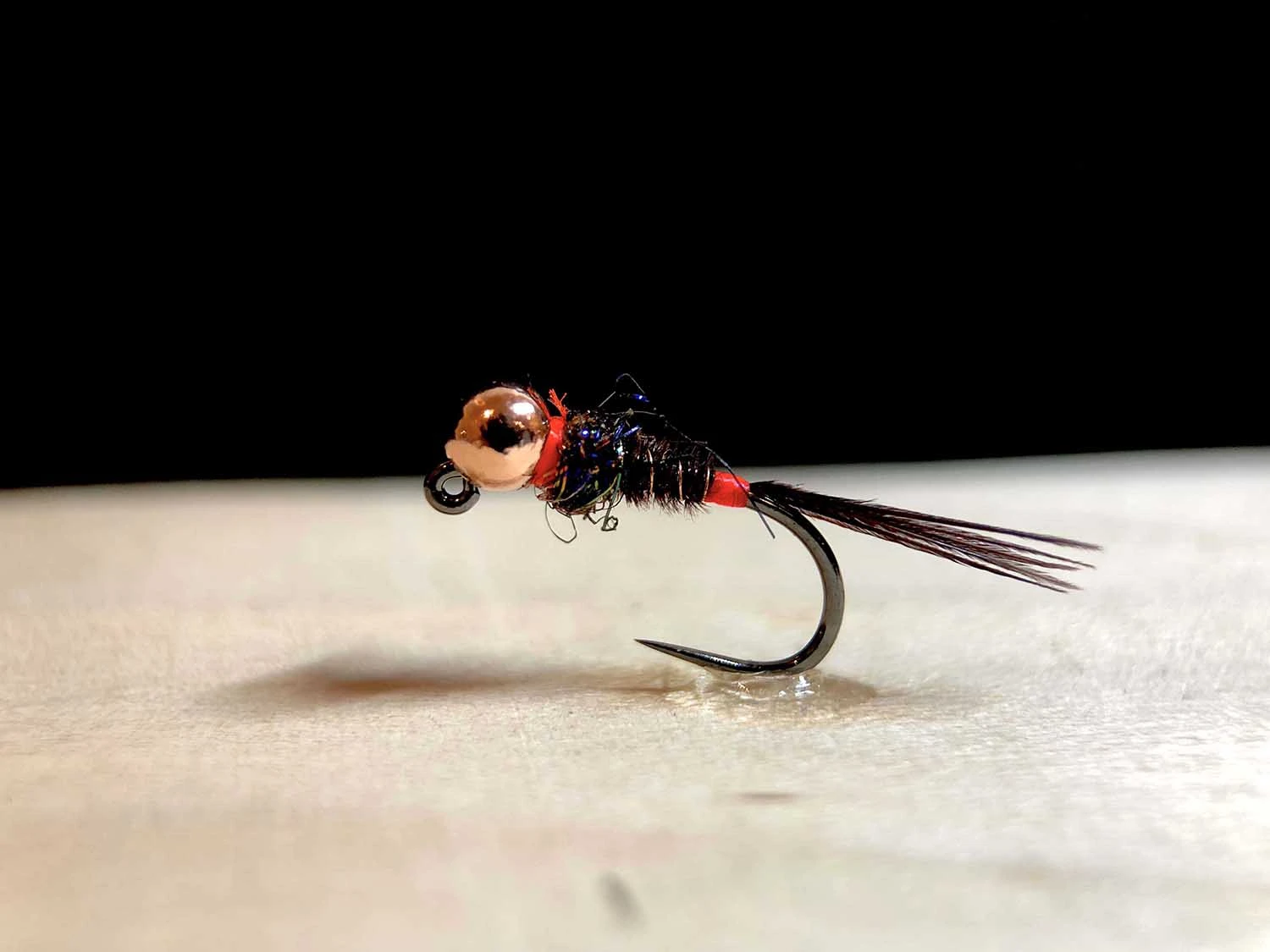
Mayfly nymphs drifting along the bottom call for a natural, neutrally buoyant imitation with a realistic profile. The Beadhead Pheasant Tail Nymph is the most versatile starting point – it covers Sulphurs, Blue-Winged Olives, Brown Drakes, and most other medium-sized mayfly nymphs in a single pattern. The American Pheasant Tail Nymph fills a similar role with a slightly leaner silhouette, and works well in sizes 14 through 18 across a wide range of river types. The Euro Pheasant Tail is a jig-style variation that sinks quickly, rides hook-point up, and is hard to snag on the bottom – useful when you are fishing heavier water with a dead drift.
For days when the food form is unclear or you want something with a little more visual appeal, the Egans Red Dart is a reliable year-round attractor. It blends features of a Frenchie and a Prince Nymph, imitating both mayfly and stonefly nymphs, and it works on presentation alone when you are not sure exactly what the trout are keyed to.
Caddis larvae and pupae require a different approach. A caddis larva sits on or near the bottom and drifts without much movement. A pupa is ascending, angling upward, which means your presentation can have a bit more life to it – a subtle swing at the end of a drift often produces. The Beadhead WD-40 is a compact, versatile pattern that covers the caddis pupa and emerger stage well, especially in the tan and olive color range that matches a wide variety of species. For a more detailed pupa imitation, the JC Electric Caddis Pupa is one of the most realistic caddis pupa patterns available. The wire inside the tubing creates natural segmentation, and the fly has a tendency to orient hook-point up as it rises through the water column – exactly the behavior of a real emerging pupa.
Midges are in the water year-round, so there is almost never a time when a midge pattern does not belong on your rig as a dropper. The Beadhead Chironomid imitates the transitional pupa stage – the phase when midges leave the bottom and ascend toward the surface film. This is often the most productive stage to target, especially in winter and early spring when trout have fewer food options. The Chironomid Midge Larva is a slightly different profile, built on a D-rib body with peacock herl, and it works particularly well at ice-off on rivers and stillwaters. The Pheasant Tail Chironomid offers a more natural look using pheasant tail and peacock, and it is effective through spring and into early winter.
Emergers bridge the gap between nymph and adult and deserve their own mention. As insects begin ascending to the surface, they become more active and more vulnerable. The Barrs Emerger – a classic BWO pattern – sits in the surface film with a shuck trailing, imitating a mayfly that has not yet fully escaped the nymphal case. Fish it in the surface film rather than fully subsurface when you see subtle, sipping rises that do not fully commit to a dry fly. The Soft Hackle BWO works similarly but can be fished with a swing, letting the soft hackle pulse as the fly crosses the current seam.
Fly Fishing Entomology
Fish With Confidence
Master the 13 key trout foods and
never guess which fly to use again
- 8 Lessons, 100+ pages
- Learn to identify any insect stage and category
- Match it to any fly in your box
- Works for any river and region trout live
- Lifetime access & coupons for over $225 in savings
- Detailed Regionalized Hatch Charts
A Streamside Inspection Example
Here is how this decision process plays out in practice. You arrive at a mid-sized freestone river on a September morning. The water is clear, running at a normal late-summer level. There is no hatch activity. No adults on the water, no rises, nothing obvious.
The first thing you do is look at the habitat in front of you. There is a good riffle upstream, a moderate run in front of you, and a slower tailout below. The substrate is rocky with mixed gravel. Based on that alone, your best starting assumptions are caddis larvae or pupae in the riffle and run, and midge pupae in the tailout.
Before you rig up, you wade in and turn over a couple of rocks in the riffle. You see small case-building caddis larvae attached to the undersides – tan-bodied, size 14 to 16. That confirms the food. You set up a two-fly rig: a Beadhead WD-40 as a point fly to imitate the pupa, and a Beadhead Pheasant Tail Nymph on a dropper above it to cover any mayfly nymphs that are also present. You dead drift this through the run.
On the third drift through a seam at the edge of the riffle, you detect a stop and set. Fish on.
Here is where most anglers fail. They arrive at the water, see no hatch activity, and either wait for something to happen or reach for a dry fly out of habit. Both approaches miss the point. The fish are not waiting for a hatch. They are already eating the nymphs and pupae that are moving through the drift every hour of the day. The common mistake is also in presentation – fishing too fast, not getting the fly deep enough, or covering water that does not have the right substrate to concentrate the food you are imitating.
If you work a riffle and tailout thoroughly with the right pattern at the right depth and still draw nothing, check your drift before you change flies. A dragging nymph, even a subtle one, is usually the problem. Slow down, add weight, shorten your leader, and get back into the current seam before you swap out.
Build a Between Hatch Plan
A useful between-hatch plan has four steps, and you can apply them on any river at any time of year.
Start subsurface by default. Unless you can see rising fish or adults in the air, assume the productive zone is below the surface. Nymphs, larvae, and pupae make up the bulk of a trout's diet on most days. Going subsurface first is not a fallback – it is the correct starting point.
Use habitat to narrow the food group. Rocky riffles point toward caddis and stoneflies. Smooth runs and tailouts point toward midges and small mayfly nymphs. Mixed habitat means a two-fly rig covering both is usually the right call. You do not need to know the exact species. You need to know the likely stage and approximate size.
Match the stage, not just the species. A mayfly nymph drifting along the bottom requires a different fly and a different drift than one that is starting to ascend. A caddis larva in its case sits still; a pupa actively rises. Matching behavior and stage will outperform a precise species match every time.
Shift to an emerger or dry only when surface feeding begins. When trout start rising consistently and you can see film activity, that is the right moment to move to an emerger like the Barrs Emerger or eventually a dry. Until that happens, stay subsurface. The transition to the surface is a short window. The subsurface window is the whole day.
If you want to build this kind of systematic reading into your everyday fishing, the Fly Fishing Entomology Course is the most direct path. It covers insect life stages, hatch timing, and the streamside field clues that connect what you see on the water to the right fly in your box. Understanding the biology behind what you are doing turns these four steps from a recipe into an instinct.
For the fly selection side, the Entomology Fishing Fly Assortment is organized around the exact food stages covered in this article – mayfly nymphs, caddis larvae and pupae, midge larvae and pupae, and emerger-stage patterns. Instead of building this box one pattern at a time, it gives you a starting collection that covers the between-hatch scenarios that come up most often.
Recommended Reading
Once you have the subsurface framework in place, the next question that comes up on the water is what to do when trout start rising. The answer is not always a dry fly. Read Are Trout Eating Emergers or Duns? to understand how to read the film and distinguish between a trout sipping in the surface and one that has committed to the adult stage – two behaviors that require completely different flies.
And when you have a hatch chart in your vest but the fish are not cooperating, Why a Hatch Chart Cannot Predict Your Day explains what hatch charts actually tell you, where they fall short, and how to use on-the-water observation to fill the gaps. Both articles build directly on the decision process outlined here.